
There’s no bushwalking topic that is quite as controversial as the concept of going “ultralight” in Tasmania. It feels like the debate is entirely polarised between traditionalists (think canvas packs, thigh length jackets, tunnel tents, Zamberlans) and the new school of ultralighters (roll-top packs, trekking pole tents, base-weight obsessed, Altras).
I personally hate the term “ultralight”. I think it helps reinforce this artificial divide and turns lightweight packing into an identity that people either claim or rail against.
I think we should replace this distinction with the concept of “packing skills”. Like any other outdoor skill, disciplined and efficient packing is something that must be developed over time, through personal experience.
At is core, it’s a problem of optimisation. The parameters are:
- Location and likely conditions.
- The nature of the trip. Will it be an easy trip with plenty of time spend in camp, or will it involve long days where you’ll either be moving, eating or sleeping?
- The margin for error. How familiar are you with the particular environment? How experienced are you? How close to your limits will the trip be?
- The gear you currently have, can borrow, or are willing to buy.
Good packing is not about reducing base-weight at any cost. It’s about rationalising (sometimes to an obsessive extent) each item you carry to maximise your enjoyment and safety. It can seem almost miraculous just how much weight can be saved by adopting this approach without compromising on your safety.
Someone who carries an unnecessary amount of weight because they take items that serve no real purpose, have multiple items that can do the same thing or could easily be replaced with lighter alternatives, has poor packing skills.
Equally, someone who finds themselves in trouble because they copied the packing list of their favourite thru-hiking Youtuber, but has a limited knowledge of where they are going and no personal experience with really bad weather, has poor packing skills.
While good packing is an essential part of a well-rounded outdoor skillset, it often seems to get overlooked, particularly by experienced bushwalkers.
Sometimes this comes down to routine: it’s very easy to keep packing what you’ve always packed out of habit. While this is understandable, it doesn’t allow for experimentation and the constant search for improvement which is central for building good packing skills.
A big part of the reluctance to reduce pack weight, ultimately comes down to a hostility towards the idea that disciplined packing is a skill, and an assumption that those with a light pack have simply made a decision to compromise on their safety and comfort. I think many skeptics of minimalist packing would be surprised to see what a really skilled packer actually carries.
The main arguments against “going ultralight” in Tasmania are:
-
Packing light is risky.
There is a prevailing assumption that a walker carrying a 25kg pack full of extra gear and “just in case” items is taking less risk than an experienced walker with a carefully considered 12kg pack. I think that the opposite is true. Carrying a heavy pack is risky. It makes falls much more consequential and increases the likelihood of sprains, overuse and back injuries, all of which can become life-threatening in certain situations. It also more generally increases fatigue, which impacts everything from your ability to deal with emergency situations to your ability to maintain body heat. Speed is an overlooked aspect of safety when it comes to bushwalking. Being slowed down by a heavy pack can mean not making it to a critical campsite by nightfall, being unable to get down from a ridgeline before the weather hits or finding yourself unable to warm up due to the slow pace.
Obviously, carrying inadequate gear is a huge risk. But carrying excessive gear is a risk as well. Once your safety fundamentals have been covered (communications, insulation, shelter, basic first aid) any additional items will have diminishing returns in terms of overall safety, and these have to outweigh the very real risk of a heavier pack.
-
The Tasmanian bush is too harsh on gear.
This is the argument I hear the most in the Tasmanian context. While Tassie has many diverse environments and different standards of track, it’s true that certain places such as the South-West (and anywhere scrubby or off-track) can be particularly hard on gear. The dense, hardy vegetation and abrasive rock makes short work of packs and outerwear.
This should absolutely be factored into your packing, but the difference it will make in terms of overall weight is surprisingly minimal. The only items that are actually effected are: packs, wet weather gear, and to a lesser extent clothes and footwear.
Packs:
This is the most significant item where durability is a big concern. Many ultralight packs are not designed to resist tears and abrasion. This is particularly noticeable in packs from a decade or so ago, when there seemed to be a bit of an arms race to go as light as possible at the expense of all else. This is why canvas has previously been considered to be the only durable choice for harder Tassie bushwalking.
This is no longer the case. With the introduction of fabrics such as Challenge Ultra and its competitors, there is simply no advantage to canvas. These new fabrics are much lighter, waterproof, don’t gain much weight when wet, and (for higher-denier options) they are actually significantly more abrasion resistant than canvas.
For some examples of ultralight packs made specifically for Tasmanian conditions (which can be as much as 1.5-2kg lighter than their canvas equivalents) check out https://www.scopariadesigns.com/
Waterproofs:
The traditional solution for hard wearing outerwear has been tough (often thigh-length) classic Australian bushwalking jackets. These hold up well, but like all waterproof they will degrade with enough use. They are also very bulky and can tip the scales at close to 1kg.
While extremely lightweight shells are less appropriate as they can literally get torn to shreds in very scrubby environments, most modern light three-layer shells will be adequate. They won’t pose a safety risk, but may have a disappointing lifespan with frequent use.
The best solution in terms of weight to durability ratio are high-end high-denier (face fabric of 80-100d +) alpine shells. These will be tough, high performing and very protective while maintaining impressively low weights. They do however, have an equally impressive price-tag.
Other Gear:
Some walkers might choose more scrub-resistant clothing, particularly pants and long-sleeve button up shirts. However truly tough clothing such as heavy waxed-cotton has significant drawbacks and is rarely used these days. Items like gaiters and scrub gloves may also add a bit of weight.
In total, a South-West scrub worthy kit shouldn’t be much more than 500g heavier than a similar set-up for a less abrasive environment.
-
Tasmanian weather is too extreme/unpredictable to pack light
While I think the “uniqueness” of Tasmanian weather is somewhat overstated (there are many places in the world that face far more extreme conditions than we do!), the weather in Tasmania is still something that should be taken very seriously. It is after all, one of the leading causes of death in the outdoors, and the number one consideration when we talk about “safety”.
The biggest challenges posed by Tasmanian weather (particularly for those who are not used to alpine micro-climates) are it’s changeability, and the “wet-cold”.
Unstable, unpredictable weather does change how you pack, and adds in more “unknowns” that must be accounted for. This is why experience (particularly location specific experience) is necessary for very minimalist packing, and why walkers (particularly beginners) should be wary of blinding copying the packing lists.
When temperatures hover around freezing (common at all times of year in Tassie) managing dampness can be a real problem. While very cold conditions have their own challenges, it is often easier to keep dry as water exposed to the air stays frozen. Many people used to colder conditions are surprised at how treacherous the relatively mild temperatures of a Tasmanian cold front can be! This wet-cold (especially when combined with high winds, and damp, overgrown vegetation) means that you must pack for a colder environment than the temperatures would suggest. It might also affect the choice of material (eg. choosing synthetic instead of down for mid-layers).
Factoring in unpredictability, and the wet-cold will inevitably add a small amount of additional weight to your pack. However, I think dealing with bad weather is as much about how you use your gear, as it is about what gear you bring. I’ve seen many people carry multiple baselayers and warm layers only to get every single one wet and end up damp and shivering in their sleeping bag. The basic system of always keeping your camp base-layers dry, and wearing the same dedicated set of walking layers is key. As is being proactive with your layering and maintaining body heat through movement. These are things that can only be mastered with experience, but they allow for fined-tuned packing even in very nasty, unpredictable conditions.
Factoring in unknown weather into your packing does not go against “ultralight” principles. Those with less experience should be cautious, and allow a wider margin for error, but there’s no reason to abandon the mentality of discipline and rationalization.
-
Ultralight gear is too expensive.
For me, this is the most peruasive argument. There is no getting around the fact that your key items (shelter, sleep system, pack) will cost a lot if you choose the high-end lightweight options. However, in my experience, going high-end for these “big-three” items, have accounted for less than half of my weight savings over the years. A huge amount of weight can be saved by rationalizing all the other items you carry. This is a gradual process that is driven by constant tweaking and experimentation to find out what works for you. It can actually save you money as you realize that you can do without many of the non-essential products you would otherwise buy.
I’ve written an article about buying gear on a budget: https://wildernessexpeditions.net.au/buying-bushwalking-gear-on-a-budget/
-
I get cold easily so I can’t pack light.
It always amazes me how different people are when it comes to maintaining body temperature. This is particularly apparent when sleeping and why making sleeping bag recommendations is so difficult.
I’m lucky enough to run very warm and I can get away with a much lighter sleep system. For a given trip, someone who runs very cold might need a warmer bag (+300g), mat (+150g), an additional midlayer (+400g) and perhaps some additional gloves/headwear (+150g). An additional 1kg is not insignificant, but given that the difference between a heavy packer and a light packer on a multi-day trip could be upwards of 10kg it is minor in the scheme of things. Assuming everything else is optimized, a cold sleeper can still pack very light.
Packing skills are personal. Being a good packer means you know what works for you. As I’ve mentioned previously, copying other people’s gear lists is not a substitute for developing these skills yourself.
-
Light tents are not strong enough for alpine campsites.
I’ve covered this point in detail here: https://wildernessexpeditions.net.au/tents-in-tasmania/
Alpine camping in Tasmanian can pose some unique difficulties: Campsites options are often limited and extremely exposed, sites can be small and awkward, and it’s often difficult to get solid anchors (either too rocky or too soft). Wooden tent platforms can also make pitching tricky.
While strong tents are a necessity of these kind of trips, the idea that the new lightweight options are not up to the task is a misconception. There are many (albeit expensive) tents and trekking pole shelters that truly do perform well in the wind despite their low weight. The caveat is that these usually require experience, advanced skills and good judgement to use them safely in more serious and committing trips.
-
Tasmanian terrain is too rough/muddy for lightweight footwear.
This is another big topic and my full article on this topic is here: https://wildernessexpeditions.net.au/choosing-the-right-footwear-for-tasmanian-terrain
The idea that heavy, full-grain leather boots are a necessity is wrong. They do have certain advantages (most notably superior longevity) and for very-rugged and off-track walks they are still the most common choice, but they are not the only choice. Other forms of footwear have their own advantages when it comes to technical terrain. Once again, it comes down to personal preference.
-
I don’t want to be uncomfortable.
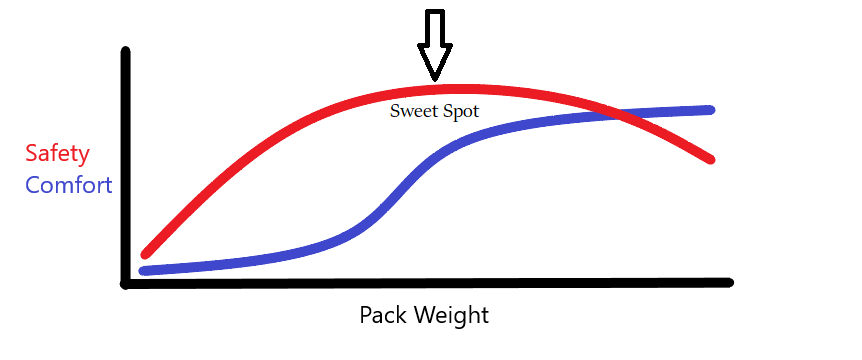
A big misconception is that reducing pack weight means reducing comfort. It’s true that at the lightest end of the spectrum, many people prioritize the ability to cover a lot of ground over enjoying their time in camp, but it ultimately comes down to what you are optimizing for. If you prefer comfort in camp and have a few luxury items that you know makes the trip worthwhile for you, you can still adopt a highly disciplined approach to your packing. After all, a light pack is the ultimate comfort.
A critical skill to develop is knowing which items make the biggest difference to your comfort. As always, this can only come through experience and experimentation. Generally I’ve found that once a few key items are included, adding extra items only marginally increases overall comfort. Finding a “sweet spot” of comfort means you can easily tailor your base-weight to comfort ratio by adding or subtracting a couple of items.
Is Ultralight a new phenomenon?
The “modern” ultralight movement has in roots in the US in the 1990’s, thanks to pioneers such as Ray Jardine (who in the world of rock-climbing is better known for inventing the cam).
However, minimalist packing has been around for a lot longer, even in Tasmania! If you look at photos from the early days of recreational bushwalking in Tassie (1930s – 50s) it’s surprising just how small the packs are, especially when you consider the kind of gear and food that they would have carried. I recently flicked through a copy of a 1950’s log-book from Tahune Hut. Listing pack weights was apparently popular back then, and while some sounded painfully heavy, many would be considered respectably light even by today’s standards.
I’ve heard of walkers in the 1960s and 70s carrying a base weight of around 5kg for extended trips in the South-West. There are also reports from those days of incredibly fast trips such as Eldon Bluff in three days, Precipitous Bluff in two days, and most amazingly, Diamond Peak in two days! While these people were no doubt in the minority, and probably had to deal with a certain amount of hardship, it shows what is possible even without modern, high-end gear.
Of course, all this seems trivial when you consider that the Palawa people have lived in Tasmania for tens of thousands of years (including through the last glacial maximum) with nothing resembling outdoor “gear”.
