
Why Use Gaiters?
Leeches:
A lot of walkers can be quite squeamish about leeches and see gaiters as a fool-proof prevention strategy. Unfortunately, leeches have an almost miraculous ability to squeeze through tiny gaps, and all gaiters will do is provide cover while they feast on your lower legs. Bare legs are (surprisingly) the best defense against leeches.
Snakebite:
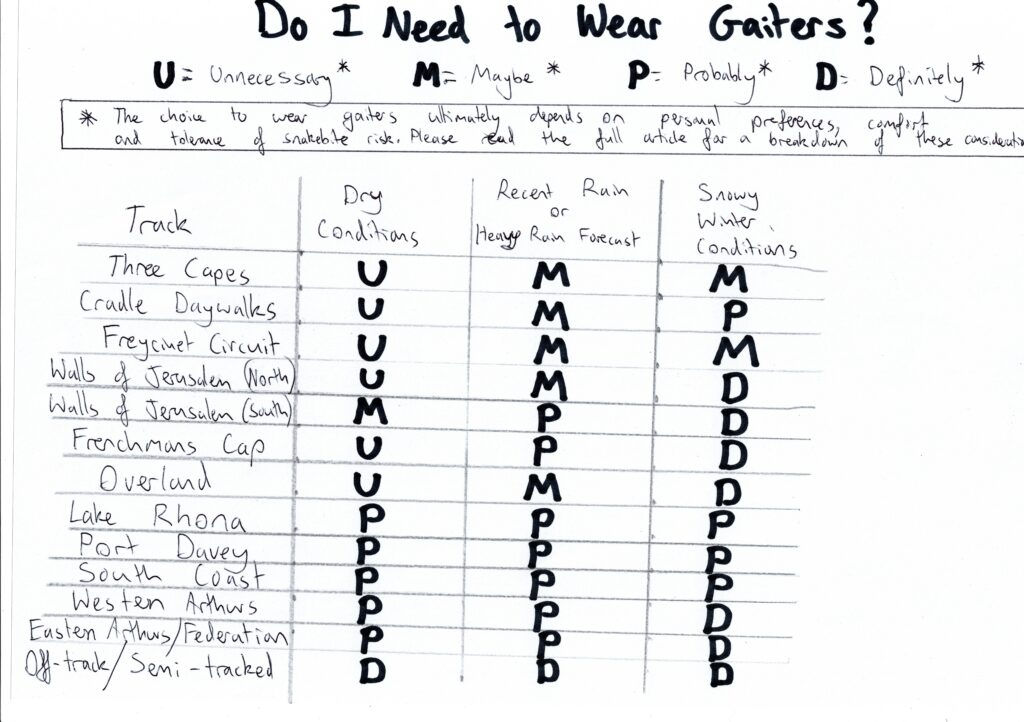
Protection against snakebite is one of the main arguments in favour of gaiters, and probably the only reason to wear them on tracks that are free of mud and scrub.
However, it’s hard to find any solid data on the efficacy of gaiters for preventing envenomation. There also doesn’t seem to have been much in the way of real-world testing (for obvious reasons) of whether the fangs of Tasmania’s snake species (Tigers, Copperheads, White-Lipped) can penetrate common gaiter materials. Nevertheless, most people would feel safer with a hefty layer of Cordura or canvas between their shins and a striking Tiger Snake. It’s a pretty reasonable assumption that gaiters should reduce the risk of envenomation, it’s just a question of to what degree.
It really comes down to personal tolerance of the risk. If mitigating the risk of snakebite overwhelms all your other considerations, than yes, wearing gaiters at all times is probably safest. However, it is worth considering that the risk of snakebite is statistically incredibly low (compared to other risks in the outdoors), so while there may be some margin of safety gained by wearing them, it is negligible in the broader scheme of things.
Debris:
Gaiters do a very good job of preventing things from getting inside your footwear. This is more useful on terrain with a loose surface (sand, pebbles, dirt), or off-track where sticks, leaf-litter and general debris has a tendency to accumulate in the collar of your footwear.
Waterproofing:
Gaiters do a bit to prevent water from getting into your shoe/boot, but this effect is limited. While some gaiters use a waterproof membrane, this isn’t anymore effective than standard non-waterproof materials such as Nylon or canvas. The reality is, if the puddles are deep enough and if the rain is prolonged enough, water will find it’s way in and gaiters will only delay this inevitability.
Mud:
Tassie’s notoriously deep mud holes are probably the biggest motivation for gaiter use. Gaiters will seal the top of your footwear, stop your pants riding up and help keep things a little cleaner. On the tracks where truly deep mud is expected (shin to knee deep rather than just ankle deep) the vast majority of walkers will be wearing gaiters. Having said this, gaiter use in these conditions is still a matter of comfort rather than necessity. You can wade through deep mud without gaiters, just be prepared for very dirty legs and rinse out your socks and footwear.
Scrub:
Dense, scratchy Tasmanian vegetation can wreak havoc on exposed limbs. While pants will provide some protection, they tend to ride up and can get shredded around the shins and ankles in very scrubby, abrasive terrain. For off-track walking and the many tracks that are so scrubby they may as well be off-track, gaiters are very highly recommended. For tracks that are more open and well-maintained, it really depends on your personal tolerance. Many people seem to be impervious to scrub scratching against bare skin, while others can find it almost unbearable.
Snow:
When there’s deep snow to stomp through, gaiters are a very good idea. They will help keep your feet dry and warm, and protect your shins/ankles from exposure to the cold snow. Some alpine shell pants will be designed to attach to your boot to provide a similar effect.
Gaiter Options:
Full Length Canvas Gaiters:
The classic option for Tasmanian bushwalking. Expensive, but very durable and protective.
Waterproof Gaiters:
Usually a full-length gaiter with a waterproof-breathable membrane. May be slightly more breathable than canvas gaiters, but doesn’t provide any more effective waterproofing and will generally be less breathable.
Short Gaiters:
Less protective against scrub and snakebite, but will seal your footwear.
Trail Running Ankle Gaiters:
Soft, light and breathable designed to seal the tops of trail shoes. They keep debris and mud out, but offer no waterproofing or protection.
Shin Gaiters:
Padded, breathable shin protection designed to fit like a compression garment. Less durable than traditional canvas gaiters, but very light and much lower profile.
