
What makes a shoe good in technical terrain? What do you want on your feet when venturing into areas that attract adjectives such as “rugged”, “rough” and “gnarly”?
The answer to this question often seems obscured by a fog of vagueness, baseless assumptions, confused terminology, marketing spin and outright misinformation.
To cut through to something close to a useful answer, it’s important to clarify some of the common terms that get tossed around.
Technical Terrain:
The simple definition of technical terrain is anything that isn’t flat and smooth. Given the huge varieties in the types of terrain that could be considered “technical” arriving at a more exhaustive definition is a pointless task. I will point out some of the specific types of terrain and their footwear requirements later on.
Support:
Support is probably the most notoriously vague concepts when it comes to footwear. Are we talking about arch support? Pronation control? Resistance to ankle rolls? Each of these considerations have very different mechanics. “Ankle support” is often considered a requirement for technical terrain and/or heavy packs. I think this focus on ankle support is unhelpful as it ignores many of the other important factors that contribute to fatigue and injuries on uneven ground. Those in favour of low-cut footwear will often challenge this and even suggest that ankle support is a myth. I think this is partially true. While some stiff, high-cut boots can actively prevent an ankle roll, the reality is that most soft mid-cut boots will provide very little resistance once your ankle has tipped beyond a certain point.
When it comes to technical terrain, I define support as: a reduction of the mobility and muscular effort required from the foot due to the structure of the shoe.
Supportive shoes mean that the foot (and to a lesser extent the ankle, in stiff high-cut boots) experience less strain on uneven footing. However, this can result in stresses being directed elsewhere, and doesn’t necessarily result in more comfort or decreased fatigue. More supportive boots and shoes will often have a higher drop (difference in height between the heel and the forefoot) which will reduce the flexion required of the ankle, particularly on inclines.
Stability:
Another conceptually vague characteristic (which commonly gets confused with support) is stability. In the world of road running, “stability” almost exclusively refers to shoes that have some form of pronation control (resistance to the ankle collapsing inwards with foot strike). While this is partially related to my definition of support, in technical terrain it has less relevance due to the varied nature of each footfall, and most trail running/hiking shoes don’t attempt to control pronation in the same way that stability road running shoes do.
There are two distinct aspects to stability:
- Shoe Stability: The stability of the shoe relative to the foot. Stable shoes will feel very “connected” to your foot with minimal play or sloppiness. You will have precise control over the sole of your shoe. Shoe stability is a product first and foremost of fit. Shoes that are too large, too wide or the wrong shape for your foot will be unstable. The firmness of the midsole is also important. Shoes with a very thick, very soft midsole will not be able to provide a stable platform, particularly on off-camber footing. A less obvious aspect of stability is the stiffness of the sole relative to the shoe’s “foothold”. Shoe with high stiffness (both lengthways and torsional) but poor foothold (how well the upper secures the foot) can feel twitchy and unpredictable, especially during a misstep.
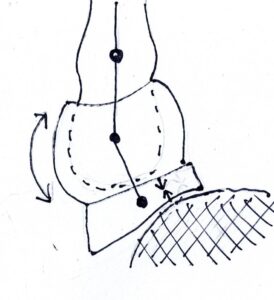
- Ankle Stability. The stability of the foot relative to the ankle. This is determined primarily by the height of the foot off the ground (stack height) relative to the base width of the shoe. While many shoes and boots may claim to have stabilizing features, the basic physics involved is difficult to overcome. The higher your foot (especially the heel) is off the ground, the more prone to an ankle sprain it is.
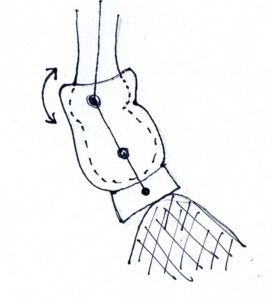
Meaningful ankle support in a boot is rarer than is conventionally thought. There has been very little clinical research on the topic and the available evidence is mixed and of questionable relevance. From my (very unscientific) experimentation I tend to find that only ski boots or very stiff mountaineering boots will actually prevent an ankle roll. You can roll an ankle even in high-cut, tightly laced hiking boots. Most modern lightweight mid-cut hiking boots will have negligible resistance.
Edging
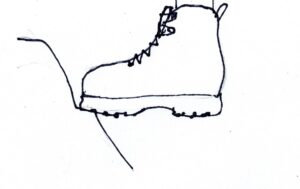
Using the sharp edge of the shoe to catch on a small hold. Requires a firm edge and stiffness to support the foot. Traction comes from the hardness of the edge. Similar movements in a broader context include: using the edge of a boot to get purchase in off-camber mud, kicking into snow or loose scree.
Smearing
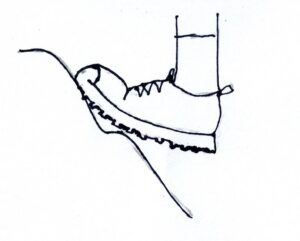
Pressing the sole of your shoe against the rock to maximize the surface area of contact. Requires ankle mobility and a softer sole. Traction comes from the sticky-ness of the rubber. Similar movements: matching the slope of a rock while boulder hopping, flattening your foot against a muddy slope to let the lugs bite.
Ground-feel
How well the foot can sense and react what is under it. Lower stack height generally allows greater sensitivity. Ground-feel means the foot and body can react quickly and intuitively to destabilizing forces.
Protection
Protection from sharp things below, impacts for the front side and above, and the ankles.
Precision
Ability for the foot to precisely target small areas of good footing. Bigger, heavier and sloppier shoes are more likely to catch on things, and land awkwardly.
Footwear Categories Compared:
Stiff Mountaineering Boots:
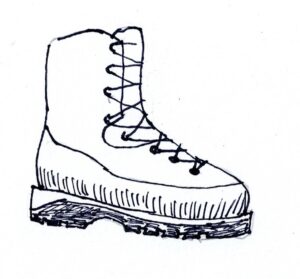
-Examples: La Sportiva Nepal, Scarpa Mont Blanc Pro
-Support 5/5, Shoe Stability: 4/5, Ankle Stability: 4/5, Edging: 5/5, Smearing: 1/5, Ground-feel: 1/5 Protection: 5/5, Precision: 1/5,
-Allows you to kick into snow and soft ground.
-Can stand on small holds with little stress on feet.
-The feet and ankles generally have to do less work.
Strengths: Moving slowly with footing that is consistently steep, loose or on snow (both firm and soft). Can edge well on small footholds.
Weaknesses: Moving quickly through boulder fields, or awkward and uneven terrain. Generally only recommended for snow, or mountaineering.
High-Cut Hiking boots:
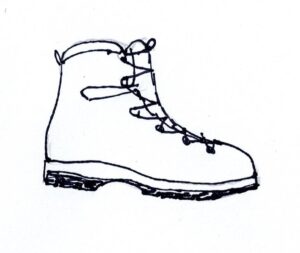
-Examples: Scarpa Delta, Zamberlan Tofane, Lowa Ranger
-Support 4/5, Shoe Stability: 3/5, Ankle Stability: 3/5, Edging: 4/5, Smearing: 2/5, Ground Feel: 2/5, Precision: 2/5. Protection: 4/5
-Some stiffness allows edging, and the higher-cut/structured uppers makes the shoe itself stable on uneven ground, protects the foot and ankle and lessens the stress on the feet. However the higher stack lessens ground-feel and precision and can increase ankle instability.
Strengths: Moving slowly through various kinds of technical terrain, where protection of the foot is important.
Weaknesses: A higher cut does not actively prevent ankle rolls. Less precision/ground feel.
Walking Shoes/Approach Shoes/Light Mid-Cut Boots:
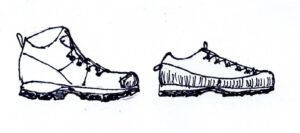
Support 3/5, Shoe Stability: 3/5, Ankle stability: 2/5, Edging: 3/5, Smearing: 3/5, Ground feel: 2/5, Precision: 3/5. Protection: 3/5
-Examples: Keen Targhee Low, Salomon X-Ultra Mid, La Sportiva TX4
-Generally stiffer, more protective and more structured than trail runners, but more flexible than traditional hiking boots.
Pros: Versatile, more precise and better at smearing than stiffer boots.
Cons: Can be unstable if a higher stack, or if there’s an overly stiff sole paired with a loose, unstructured and poorly fitting upper.
Highly Cushioned Trail Runners:
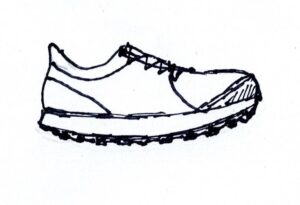
Support: 2/5, Shoe Stability: 2/5, Ankle stability: 1/5, edging: 2/5, Smearing: 3/5 Ground-Feel: 3/5, Protection 2/5 Precision 3/5
-Examples: Hoka Mafate, Salomon Ultra Glide, The North Face Enduris
-Higher stack height and a loose less structured upper, means less shoe stability and less ankle stability.
Pros: Good at lightly technical terrain (ie. Generally smooth trails with occasional rocks/roots), where small bumps can be absorbed by the midsole without disturbing the foot. Good underfoot protection.
Weaknesses: Generally less stable and precise than more technical trail runners. Poor edging ability.
Technical Trail Runners:
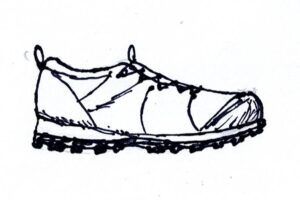
Support 2/5, Shoe Stability: 4/5, Ankle Stability: 4/5, Edging: 2/5, Smearing: 4/5, Ground Feel: 4/5, Protection: 3/5, Precision: 4/5
-Examples: La Sportiva Bushido, VJ Xtrm, Arc’teryx Vertex Alpine
Moderately stiff, lower stack runners with protective, structured uppers that provide a secure
Pros: Precise, protective and stable, good on a variety of technical terrain at higher speeds.
Weaknesses: Less edging ability. Requires the foot and ankle to be more engaged than hiking/mountaineering boots. Not as protective as hiking or mountaineering boots.
Minimalist Shoes:
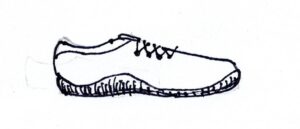
Support 0/5, Shoe Stability: 4/5, Ankle Stability 5/5, Edging 1/5, Smearing 5/5, Ground Feel 5/5, Protection 1/5, Precision 5/5.
Examples: Vibram 5-Fingers, Altra Lone Peak, NNormal Kjerag
Very flexible, very low stack, very light. Does little to change the natural movement of the foot.
Pros: Excellent ground-feel, stability, smearing and precision. The foot can naturally adjust and “mold” to awkward footing.
Weaknesses: The lack of protection may make them too extreme a choice for most. The lack of edging can be problematic in certain conditions such as snow, or steep loose surfaces.
Traction
While traction is influenced by the structure of the shoe in the ways outlined above, it is largely dependent on the outsole, which can vary enormously between shoes.
Soft Ground Traction:
Traction in mud, turf, loose gravel and other soft surfaces is determined by the lugs. Traditional hiking and mountaineering boots will have broad rectangular lugs that come to a hard edge around the perimeter of the outsole. These are designed to complement edging abilities of these boots by “sawing” into the ground to gain purchase. Mud focused trail runners will have many sharp and widely spaced lugs (a bit like the cleats on football shoes) which bite into the ground when smearing and shed mud easily. Generally, the shallower lugs will have less traction on soft ground.
Hard Ground Traction:
Traction on firm, slippery surfaces (eg. slick rocks and slimy roots) is determined partially by tread pattern, but primarily by the rubber compound used in the outsole. Outsoles with a greater surface area of contact (think climbing shoes) will have better friction overall. While this does mean that aggressive, mud focused outsoles will have less friction than a smooth toed approach shoe, the “stickiness” of the rubber has a much more important role. Traditional boots tend to have harder wearing outsoles to optimize longevity, while trail runners will use softer rubber that will wear quickly but has greater friction. Some of the best outsoles for hard surfaces include Vibram Megagrip, VJ’s Butyl Rubber and La Sportiva’s Frixion White and Red.
On slippery rock, boots can use their edging abilities on sharp, positive footholds, or sections where the boot can be securely wedged between angled surfaces. More flexible shoes will be more able to match the slope of the rock, maximizing the area of contact and allowing the higher friction rubber to do it’s magic.
